Monday, November 12, 2012

How do YOU Teach Helpfulness?


One thing I love about Conscious Discipline is the fact that it isn't another curriculum add-on.  Rather, it consists of skills you can teach children throughout the day in many different ways.  Over the years, I have found many rich lessons to help teach Conscious Discipline skills right in the midst of a favorite story, movie, or other activity! 

In our Shining Star School Family we have been focusing on what it means to be helpful.  We have been reading stories and noticing the helpful acts of those around us.  We have taken photos of children "caught in the act" of being helpful.  Those photos are used to make class books, posters, and routine books that will encourage helpfulness in all children.  I am often surprised at how often even a child who is five-years-old doesn't know what it means to "be helpful".  We are expecting children to do something they really don't know how to do!  That's why we take every opportunity we can to encourage it in our classroom! 

This time of year, as we talk about topics such as families, food, and where we live, one of my all time favorite tales to share with children is "The Three Billy Goats Gruff".


Preschoolers are captivated by the various personalities of the characters in the story. (I also think they love the way Ms. Jenny changes her voice for each character)   They jump at the opportunity to act out the story using various props and taking their turn at being each character.  This year, I jumped for joy when I found the most recent publication of this favorite tale.  This new favorite is titled "The Three Billy Goats Fluff". 


Oh my goodness!  It is absolutely adorable and so very useful in our pursuit to teach the Shining Stars about helpfulness, problem solving, and emotional regulation!  The author brilliantly puts a positive twist on this old tale!    We followed our reading of Paul Galdone's version of the tale with this new version.  The children were familiar with how rude the original troll was and how the billy goats used a very hurtful plan to "handle" the troll.  In "Billy Goats Fluff" we learned that with a little problem solving help from their Safekeeper (mom) the billy goats could help the Troll AND find a way to quietly cross the bridge to the grassy hill. 


To help illustrate the contrast between the two stories we acted out the "trip trapping" of hooves across the bridge using wooden blocks.  We listeded to the blocks on our wooden bridge first without socks.  Then we listened to the blocks cross the bridge with fuzzy socks on them.  They were so quiet!  The children loved making predictions about how the "hooves" would sound.  We also used various musical instruments to further impress the difference between loud and quiet.  This activity was a great opportunity for us to learn how our voices/noises we make affect those around us. 


You'll have to read the whole story to find out more, but one of my favorite lessons from the story is when the first billy goat Fluff feels scared and runs home to Mommy.  After reading this portion of the story, we paused to relate this experience to our Feeling Buddies.  The message of the Feeling Buddy, Scared, is "find a safekeeper".  So we pulled out our Feeling Buddy, Scared, and remembered that message and how helpful it was for the billy goat.  With the help of their Safekeeper (mom) the goats were able to come up with a plan that allowed them to eat grass and help the Troll enjoy his "vacation" under the bridge.


This is a sample of what the Feeling Buddies Self-Regulation Center looks like from Conscious Discipline.  It is magical to see how well the children relate to the Feeling Buddies as they are learning how to befriend their feelings.  I plan to post more about using the Feeling Buddies in the classroom later this year!  You might like to check it out at www.consciousdiscipline.com under the product tab.

Thursday, November 8, 2012

While You Wait...


Speaking of waiting, you've waited a long time for my next post!  I don't know about you, but I have a hard time waiting.  No matter what we think about it, at some point in our lives we all have to wait.  We might as well learn how to handle it!  Whether it's at the doctor's office, grocery store, bank, or waiting for Christmas, you have to admit, it's hard to wait!  I have learned over the years to come prepared so that I have something to do while I wait.  Sometimes I bring a book or magazine or I might even find a new game to play on my phone.  When I'm waiting for a special event like Christmas I pass the time preparing for the holiday and enjoy creating memories along the way with family and friends. 

Once I had children of my own, I knew it was best to come prepared.  I never left the house without a little something in the car, diaper bag, or in the bottom of my purse that could help us pass the time if we had to wait.  Even though my children are now nine and eleven, I still keep dry erase boards and trivia cards in the van just in case we get stuck in traffic or practice runs a little long.  When I have something to do to help me make better use of my time, I am more likely to stay calm and enjoy my wait rather than become upset and allowing the "wait" to be in charge of my feelings.

I try to carry this same "always be prepared" attitude into my preschool classroom.  It pains me to see children waste time while they wait for others to finish various classroom activities.  My goal is to keep each child engaged and maximize their time with us!  In order to help set us up for success, I have arranged our schedule and special tools to help children with these transitions and "waiting time". 


This school year has been an exciting opportunity for me to fine tune more of my Conscious Discipline skills.  Arrival time was going so well, but when we transitioned to our School Family Meeting time the room errupted in chaos!  I reflected on why Arrival Time was going so well and I realized it was because the children had lots of structure and routine to help them feel safe.  This is the simplest idea, but it works like magic!  When it is time for the children to clean up the area where they were playing and transition to Family Meeting we added the following steps:

1. We set a visual timer that also gives an auditory cue by beeping when it's time to clean up.
2. Next, we taught the children to be a STAR instead of screaming or having a meltdown because it was time to clean-up.  STAR stands for Smile Take a deep breath And Relax.  Go to www.consciousdiscipline.com for free STAR printables.
3. Once they breathe, we play a song for them to clean up to.  The song is from Mr. Al and Dr. Becky Bailey's cd "Kindness Counts".  It is a calming tune and the children love singing along "It's in Every One of Us."
4. When they finish cleaning up their area they look to see if a friend needs help.
5. They go to circle and find a small fidget toy waiting on their spot for them to explore and play with until their friends finish cleaning up.  The best part is that during this time, they have the opportunity to practice sharing and interacting quietly with their neighbors using these small toys.
6.  Once everyone has arrived at School Family Meeting we sing a little song as we go around and collect the toys and begin our meeting.  The song goes like this:  "Picking up the tools and putting them in the basket, picking up the tools and putting them in the basket, picking jup the tools and putting them in the basket, it's time for circle to start."
7.  Success!  Now they know what to do "while they wait" in a classroom that is calm and peaceful!


Adding this simple routine and practicing it has made all the difference for our little class.
Conscious Discipline reminds us that pictures and routines bring safety and safety creates an optimal learning environment.  I have picture routine cards around the classroom to help MAP (Model, Add pictures, and Practice) the expectations for our routines. Here are samples of some of the pictures I have posted around our classroom. There are also routine cards for the toileting, hand washing, lining up, snack, self-selected reading time, and many more. The routines can be posted on the wall, made into a class book, added to a ring to take with you when you leave the classroom, or set to a song to aid in remembering.


I would encourage you to look around your classroom or reflect on different times in your day when it feels a little (or a LOT) chaotic.  Reflect on what routines and visuals you can add to that part of the day to help your children feel safe.  Model the routine, add visuals to it, and then practice it with your children.  In less than a week you will see dramatic results!

For more information on Conscious Discipline visit www.consciousdiscipline.com.  Check out this video of Dr. Bailey and Shubert using Shubert's Picture Rule Cards.


Shubert's Picture Rule Cards


Saturday, October 6, 2012

Brain Smart Start:  Activities to Connect


One thing that I have observed happening over the past few years is that in many classrooms we are telling children that they can't touch.  Often, because children haven't been taught how to touch appropriately and don't know the limits, we just tell them not to do it at all.  In Conscious Discipline, Dr. Becky Bailey emphasizes the importance of touch.  There is a large amount of research out there that demonstrates the importance of touch.  In training, I often refer to a study that Dr. Bailey shared with us that was done on NBA teams.  It was found that the teams that had the highest percentage of touch among players were the most successful teams.  How many times have you experienced the power of a gentle pat on the back or a firm hug when your spirits are down.  We all need touch!   

In Conscious Discipline we teach that in order to develop meaningful connections between children and between children and their teachers, these activities need to include four important components.  Meaningful connections are created through eye contact, touch, presence, and playfulness.

When I first started using Conscious Discipline I realized that there were many days that I didn't connect with several of my students at all.  Since I work in a classroom with children who have special needs, I often have a couple of students that need a lot of my help in order to be successful.  I was so focused on those students, that I sometimes missed meaningful moments with the other students.  Adding Activities to Connect has really created some good habits for me in the classroom.  Everyday as my students arrive at school I greet them using my greeting apron.  It is just an old tool apron from a lumber store.  I turned it over and added a couple of pieces of Velcro.  Every couple of weeks I add a new greeting for students to choose from.  I really enjoy coming up with new greetings that go along with the season or topics we are discussing in class.  Right now the class favorites are the "Pumpkin Bump" and the "Bushy Tail Squirrel".

To do the "Pumpkin Bump" you simply stand side by side and bump hips.  The "Bushy Tail Squirrel" is done by turning back to back and shaking your tails at each other like a squirrel!

I had a student that resisted coming into school each day.  He would play a game and hide from me behind the bench.  I decided to start wearing my greeting apron outside to pick him up and offer his greeting before we even got to the classroom.  Guess what!  The problem was solved!  Now everyday he eagerly lines up with the other children to receive his greeting before he enters the classroom!


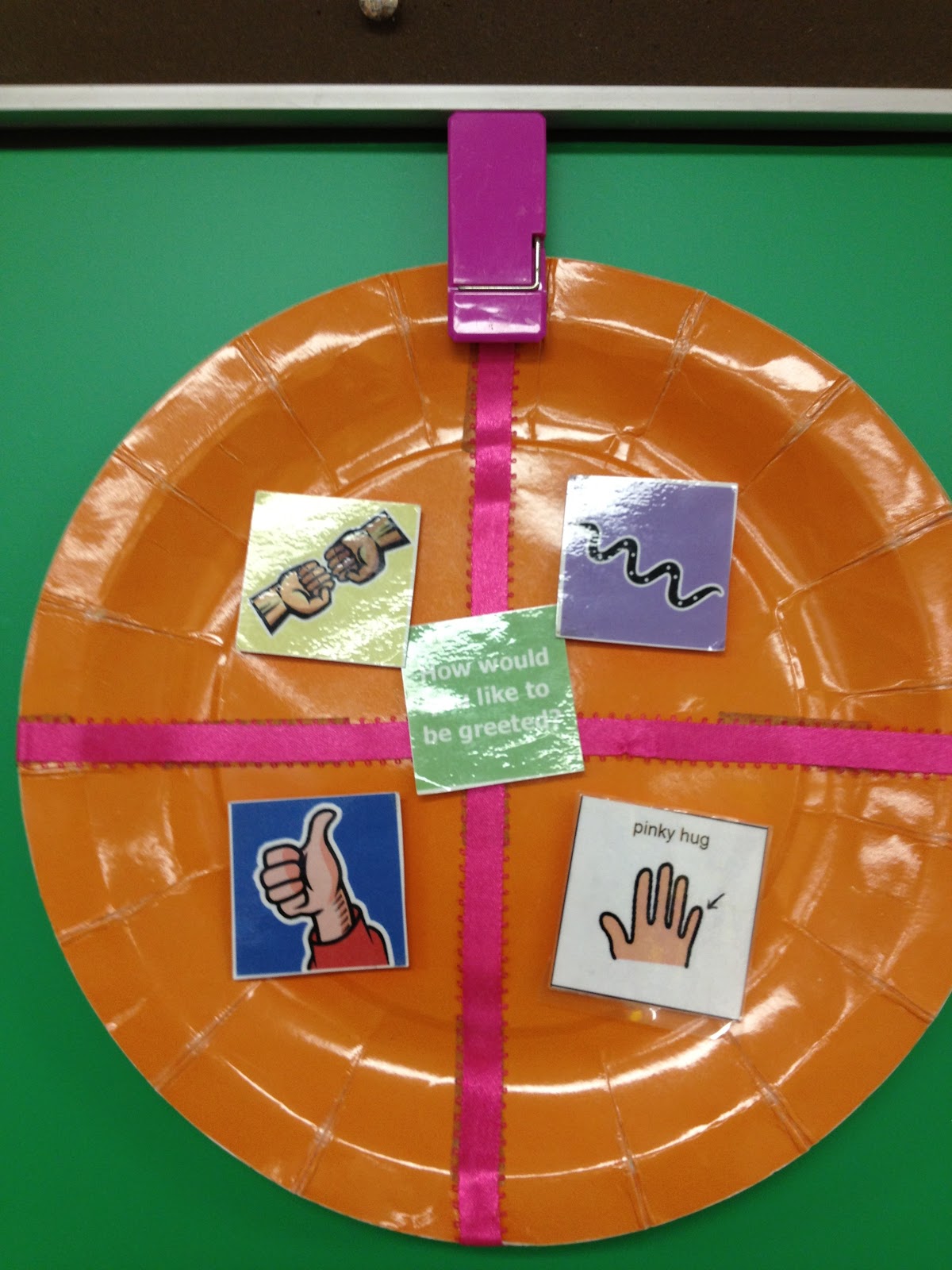
Here is a sample of what a greeting apron might look like.  These aprons offer children four choices.  It is up to you how many options you offer your students.  The younger the child, the fewer choices that should be available.  The pictures on my apron are created using Boardmarker software by Mayer Johnson.  You can find images on the Internet, use die cuts, or foam pieces from the hobby shop.  Get creative and see what you can come up with!


In addition to being greeted by the teacher upon arrival each day, my students are also greeted by one of their peers at circle time each day.  Every student in my School Family has a meaningful job.  One of those jobs is the Greeter.  As a part of circle time, my greeter goes around and asks the question "How would you like to be greeted today?"  We alter the question according to the verbal ability of each student.  For a child who is nonverbal, we use a communication device and they push a button to ask the question. 
This is the greeting plate I use for my student greeter.  It is a simple colored plate divided into equal parts using ribbon.  Velcro is attached to each section for the greetings.  When I want to introduce a new greeting, I put it on my greeting apron first.  After a few days of me using that greeting and teaching them how to do it, then I add it to the greeting plate.  That way I can be sure they are successful!

You may be saying to yourself, "I don't have time to greet every child."  I have heard from many specialists such as Fine Arts Teachers, Speech Therapists, and Instructional Assistants who have a very limited amount of time with each group of children.  You may find the following video clip helpful.  This is the Art Teacher at my school.  She sees her students every six days and sees over 1000 students in that amount of time.  She attended a 2 day Conscious Discipline training that Ignite Learning LLC sponsored with LGA, Karen Hickman this past summer.  In that training she witnessed the power of Conscious Discipline and comitted to implementing as many of the principles in her classroom as she could.  One thing she began doing right away is finding a way to greet all of her students as they arrive. 

There are other activities you can add to help give students the opportunity to connect.  You might like to check out Dr. Bailey's book "I Love You Rituals".  There are many fun finger plays, games, and positive nursery rhymes in the book that you can do with individual students or as a group.  For more information go to www.consciousdiscipline.com.


There are also many songs that offer children the opportunity to build connections as they sing along.  You might consider checking out some of the songs on these Cd's.  Some of our favorites are: "Get Ready", "School Family", "Greetings", "I Wish You Well".  For more information go to www.consciousdiscipline.com.


Wednesday, October 3, 2012

Brain Smart Start: Shining Star Song


 At the beginning of each school year I spend a lot of time teaching my students the routines that help keep us safe throughout the day.  Research shows us that the brain functions optimally when we feel safe.  In Conscious Discipline we focus on creating an optimal learning enviornment through the elements of the Brain Smart Start.  Dr. Becky Bailey has shared 4 key components to creating a Brain Smart Start:  Activities to unite, connect, disengage stress, and commit.  For more information about Conscious Discipline go to www.consciousdiscipline.com.

As I begin to implement each part of the Brain Smart Start in my classroom, one of the first things I do is help my students unite as a school family through finding identity as the "Shining Stars".  I wrote a song for our class a couple of years ago that includes all parts of the Brain Smart Start.  I modify it slightly each year to meet the needs of each specific group. 


"Shining Star Song"
(Sung to the tune of Twinkle Twinkle Little Star)

We are the Stars we sparkle and shine,
When we're together we're feeling fine!
We want our brains to work to the MAX!
So smile, take a deep breath, and relax.
Eyes and ears and hands and feet,
Use kind words with everyone you meet!


As we sing the song we sit or stand in a circle and hold hands (connect).  When we talk about our brains, we point to our brains and then on MAX we all point to the sky.  Next, we take a deep breath (disengage the stress response) together then point to each body part as we sing (commit).  Starting the song by identifying ourselves as the "Stars" is the Uniting portion of our Brain Smart Start.  See how easily you can get a Brain Smart Start in just one song???  Now that's a lot of bang for your buck! 

Here is a little video of my class singing our "Shining Star Song".  Hope you find it helpful!

Saturday, February 11, 2012

Penguin Math

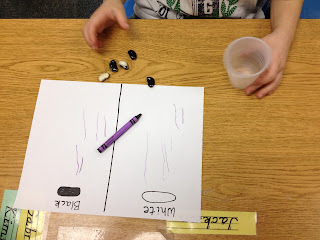
This was an old Math Their Way activity that I used years ago.  I used some dried lima beans and spray painted them black on one side.  The result was a bean with one side black and one side white.  During this small group activity, children worked on counting and tallying the results of the game.  Each child had between 3-10 "penguins" in their cup.  They shook the cup and then spilled them out on the table.  They counted how many black ones they had and how many white they had.  Then they made marks on each side of their recording sheet to reflect their results. 

It was fun to see the various abilities of my students shine through in this activity.  Some could complete the entire activity independently.  Some needed help recording their findings.  Others needed help counting and recording their findings.  Some students just enjoyed shaking and dumping and counting their penguins.  This is a great activity that can be used with children at all levels!