Tuesday, July 15, 2014

Children's Books that Teach Self-Regulation


I LOVE really good children's books!  In fact, I might just have a little bit of an obsession!

I am one happy girl when I find a book that can help me teach self-regulation skills to children!  One of my favorites is Shubert is a S.T.A.R.


In this adorable story, Shubert comes to school in a very grumpy mood.  He hurts his friend and does several other things that are unsafe.  His brilliant teacher, Mrs. Bookbinder (a beautiful butterfly), floats across the room to help. 

With the guidance of Mrs. Bookbinder, Shubert learns some new skills.  His classmates help him turn "bug crazy mad" into "caterpillar calm".

This book is very helpful when teaching your children the four calming strategies that Dr. Becky Bailey has shared with us.  They are:  S.T.A.R., Drain, Balloon, and Pretzel.  You can get some free printables for your classroom or home on the Conscious Discipline website.  Just follow this link

Once we have finished reading the story I have children share what makes them "bug crazy mad".  We use this photo of Shubert to help us get started.


Children fill in the blank and then illustrate it.  "I feel bug crazy mad when _________________." 

There are many extension activities you could do with this book!  You could have children think about what they can do to help them feel caterpillar calm.  Some examples would be listening to music, taking a bath, writing in a journal, or exercising.  Some of these are strategies that work well for the "I choose" step in the Five Steps for Self-Regulation.

Look at this simple little caterpillar craft you could make.  Imagine taking one deep breath for each hump in the little critter's back!


You could also help children make this cute little caterpillar and bug snack!  You can find more information on Little Page Turners.


Shubert has a sister named Sophie!  Recently, Dr. Bailey released a board book titled:  Sophie is a STAR.  The skills in this book are similar to the Shubert book.  The language is much simpler as it is geared for infants, toddlers, and children with special needs.


What are some of your favorite children's books?  Could you use them to help teach children life skills?  Come back on Thursday!  I'll be sharing another one of my favorites! 

Until then, I wish you well!!!


photo credit: sean dreilinger via photopin cc

Friday, July 11, 2014

Five Steps for Self-Regulation


Self-regulation is the number one skill necessary for children to be successful in school.  Did you know 40% of children enter school missing this essential skill?  Many adults struggle to teach self-regulation skills because it was never taught to them!  

I had the privilege of sharing a guest post over on Teach Preschool today about Dr. Becky Bailey’s book Managing Emotional Mayhem .  In her book, she shares the process for becoming BFF's with your own feelings.  This helps you guide children in doing the same.  Self-regulation is the ability regulate our thoughts, feelings, and actions so we can access higher levels of thinking. 


http://consciousdiscipline.com/store/pc/Managing-Emotional-Mayhem-4p158.htm
In the post I shared the steps for getting started with your own self-regulation program:  Personal Awareness, Active Calming, and the DNA Process.  Now we continue the process with the Five Steps for Self-Regulation that are also shared in Dr. Bailey's book.

When coaching a child toward self-regulation, the first step is noticing they have been triggered.  Various things can trigger a child's upset.  It is helpful to be aware of your child's triggers.

When a child has been triggered, they are overcome with an emotion.  There is usually some physical indication that they are now in a Survival State.  Such behaviors include kicking, hitting, hiding, slamming doors, biting, spitting, or putting their head down.

Step 1:  I Am
Dr. Bailey wants us to recognize that it is no longer the child you are talking to.  Now you are talking to the feeling (ie: angry, scared, sad).  This is when the DNA process begins.  Move the child to a safe place in the classroom.  For infants, toddlers, and children with developmental delays you are their safe place.  You will hold the child on your chest or lap and begin to breathe with them.  Older children can be coached to use a self-regulation station that we refer to as a Safe Place.  We are very intentional about teaching children how to use the Safe Place appropriately.  For ideas about how to set up your Safe Place check out my Pinterest board.


Step 2:  I Calm

Now that the child is safe, you can use some of the Active Calming strategies that you have taught them in advance.  Dr. Bailey offers us four basic breathing techinques:  STAR, Balloon, Pretzel, and Drain Breathing.  There are free printables as well as instructions for each breathing technique on the Conscious Discipline website.

This is a video of one of my former students doing Balloon Breathing.  Give children plenty of opportunity to practice these skills.  It's like getting ready for the big game.  You wouldn't just send a soccer team out and expect them to win without practicing.  The same is true with breathing.  Children need to practice DEEP belly breathing so they are able to disengage the stress readily in moments of upset.  It takes three deep breaths to really shut off the stress response.  


Step 3:  I Feel

The next step in the self-regulation process is helping the child identify their feeling.  Young children under the age of eight don't have any internal speech.  By using the Feeling Buddies you offer children the opportunity to develop a helpful internal dialogue.  Dr. Bailey recommends that we begin with the four basic feelings happy, sad, angry, and scared.

Feel Chart


The language goes something like this:

  1. "Hello angry."
  2. "Welcome angry."
  3. "Your eyes are like this." (demonstrate)
  4. "Your mouth is like this." (demonstrate)
  5. "You seem angry."
  6. "You are safe."  (hold the buddy close)
  7. "Breathe with me." (take several deep breaths)

Acknowledging the child's emotions helps them bridge the gap from problems to solutions.  As you connect with the child, you are guiding them toward a higher brain state.  Now problem solving can occur.  By naming the feeling the child can begin to manage it.

Step 4:  I Choose

To continue the journey toward an optimal learning state we help the child make a choice.  Some ideas that may be offered as choices are writing in a journal, connecting rituals, friends and family photos, music, relaxation techniques, books, or calming cream.  Base these choices on the preference/needs of your children.


Step 5:  I Solve

This final step in the self-regulation process helps the child revisit the trigger and approach future difficulties with new life skills.  When we started this process, the child was in a Survival State.  Teaching and learning cannot occur when a child is in a Survival State.  This process helps us guide the child back to a regulated state so they are ready for teaching and moving forward with new skills.

Conflict Resolution Time Machine
There are five categories of solutions:


  1. Conflict resolution using the Time Machine Mat.
  2. Accept and manage your feelings.
  3. Learn a new skill.
  4. Structure the environment visually for success.
  5. Establish stronger connections.
At first, this process can seem very labor intensive.  You have to teach children each of the steps and coach them through the process.  The good news is that once you give them the practice and support they need, this is something they will carry with them throughout life.  

This process can seem like learning a foreign language.  Many of us were raised to ignore, dismiss, punish, or medicate our feelings instead of recognizing and managing them.  The Feeling Buddies Curriculum by Dr. Becky Bailey is a treasure trove of information and resources that leads you step by step through this process.  Its like a two for one.  As you guide your children, you also learn to manage your own emotions!  I highly recommend you check it out!!

Stay tuned for more ideas that will help you teach children how to self-regulate so they can be successful in school AND life!!!

Until next time, I wish you well!


Friday, July 4, 2014

Independence Day: Helping Children with Developmental Opposition


Happy Fourth of July!!!  I hope you are enjoying this time with family and friends!  What a great reminder every year to celebrate our freedom! 

One thing I think of when I consider Independence Day is the Conscious Discipline Power of Free Will.  This is one of the most difficult Powers for me to really practice.  I have a deep rooted belief that if I go about it right I can still make others do what I want.

Don't we all wish sometimes that children would just cooperate?  We want them to do as we say without complaint.  I shared a post on Prek and K Sharing today about how to help children by offering Two Positive Choices.  BUT I bet we all know that child.  You know, the one that for some reason challenges you beyond your skill level.

This is the child that when given choice A or B chooses C.  Dr. Becky Bailey describes several reasons why this child may be so resistant and gives us some strategies to help us address their needs.  Over the next week I will describe the characteristics of several different types of opposition.  Today we are going to discuss Developmental Opposition and the Parroting Technique. 

Developmental Opposition
  • Individuation separation is a child's journey toward self-hood.  It transforms a helpless, dependent infant into a person with a unique identity.  Any assertive stance from an adult prompts the child to react with the opposite behavior. 
Help a child that is resistant for developmental reason by using the following strategies:
    • Avoid a power struggle by taking a deep breath, become conscious of your thoughts, and  focus on what you want the child to do.
    • Now that you are composed, choose to rely on the Power of Free Will rather than coercion to solve the problem.  Coercion is the problem, not the solution.
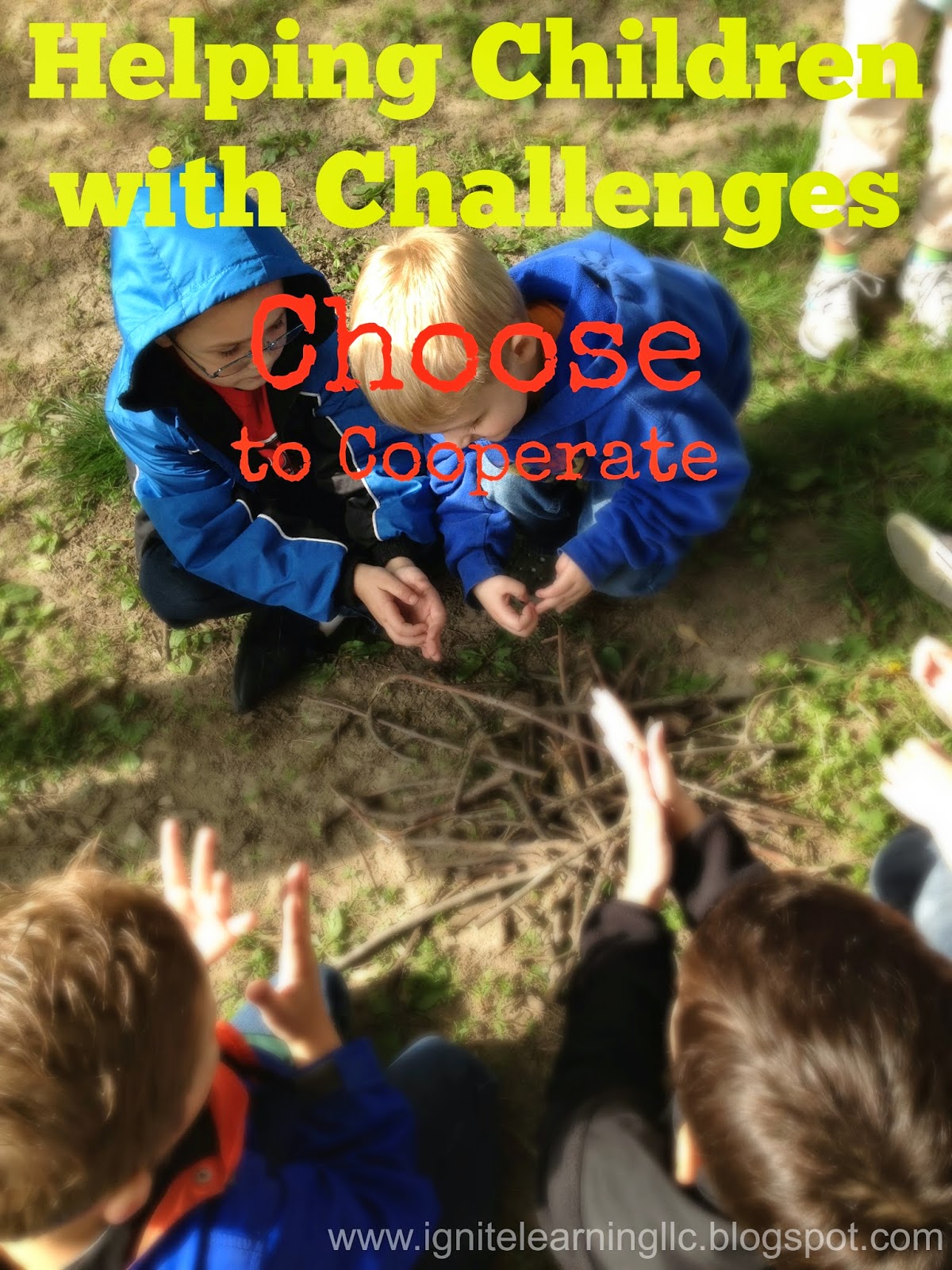
    • Use the parroting technique as demonstrated in the picture below.

When you use the parroting technique there are a few things to remember:

1. You must stay calm.  As you continue to repeat the choices remember to breathe.  The child may continue pushing you and attempt to engage in a power struggle.  Keep breathing.

2. If the child downshifts and becomes physically aggressive it is time to offer assertive commands and active calming strategies.  You cannot offer choices to a child in a Survival State.

3. Although you may need to leave the blocks on the floor for a few more minutes while the child calms down be sure to follow through with having her clean up when she returns.  Once the blocks are cleaned up celebrate her accomplishments with her.

You can learn more about opposition by tuning back in next week.  We will explore other types of resistance and share strategies about what you can do to help! 


photo credit: <a href="https://www.flickr.com/photos/hadock/3831715388/">_Hadock_</a> via <a href="http://photopin.com">photopin</a> <a href="http://creativecommons.org/licenses/by-nc-nd/2.0/">cc</a>


Tuesday, July 1, 2014

One Word 2014


Speaking of commitments, it's been exactly six months since we began our One Word journey. 

How are you doing on your goals and resolutions you set for yourself this not so new year?

Do you even remember what your goals were this year? 

As I shared in my post "Becoming Your Best Self:  One Word" my family members and I each decided to choose one word that we are focusing on throughout the year. 

These paintings are a reminder for us daily to focus on challenging ourselves to reach our goals.  It has been so cool to see this process take on a life of its own in each person's daily experience.   


As I shared in January, my one word is CLARITY.

I thought I really had a good idea about what I needed clarity on this year.  Isn't it interesting sometimes how what we think will go one way ends up going in a totally different direction!

God had different plans than I did!
 
I have found clarity in so many ways that have been meaningful for me both personally and professionally. 

So, my question for you is this...

If you chose a word for the year how is it going?  What is your word and how are you focusing on that word this year?

Maybe you sort of got busy and stressed and haven't really been very goal focused so far this year.  No worries!  You still have six more months before the year is over and that is plenty of time to make a change!

Why wait?  Start today!  Make this the best year yet!


To learn more about One Word by Jon Gordon, check out the link below.  (affiliate post)


Sunday, June 29, 2014

Are You Willing?


Last week I had the opportunity to join Loving Guidance Associate, Karen Hickman, for a two day Conscious Discipline training here in Indiana.  Over 100 people from around the state were empowered by her messages and the opportunity to learn how to help children learn from the consequences of their behavior.

Each day she challenged us to make a group commitment as well as a personal commitment.  Making commitments help us set ourselves as well as our children up for success! 

On day two of our workshop Karen asked the question "are you willing?"    She pointed out how often we say yes or no to things without really thinking through the consequences of that choice. 

Immediately, I thought about all the times I've said no to my own children before even thinking through what I was saying.

For example, I might say no to having a snack without thinking about the fact that they may really be hungry or have another need that is unmet.  You know how that goes.  As soon as you say no the whining ensues.  "But I'm huuuuuunnnnnngggggrrrrry!"  They cry.

Before you know it, I give in and let them have a snack and don't stick to the limit I initially set.   This can create a very unhealthy pattern for them AND me!

Perhaps if I'd slow down and pause when they ask for the snack and think about whether or not they really could need something to eat, I would consciously make a decision about it instead of answering while on autopilot.   

As I plan for the coming week, I am going to slow down and pause before making decisions.  I am going to intentionally ask myself, "Am I willing?" instead of getting myself into something and then later beating myself up about it and feeling disappointed or angry because of unmet expectations. 

So, my question for you is are you willing to slow down and put a pause in place before making a commitment?  Are you willing to take a deep breath and reflect instead of reacting out of the lower centers of your brain and saying or doing something you are later going to feel guilty about?

What are you willing to do this week to help set you and your children up for success?  Hope you'll join me in committing to putting in that pause and living life intentionally so you and your children can experience more joy and happiness in this journey!