Tuesday, January 19, 2016

Brain Smart Transition Tips that Work: Using Visual Supports


Stopping is hard.

Think about it.  Have you ever tried to stop smoking, stop eating chocolate, stop watching Netflix, stop speeding, or stop drinking coffee?

It's just not easy is it?!?

I think one of the biggest mistakes we make when we are making transitions with children is that we forget what it is like to be 2, 3, or even 8 years old!

We forget how hard it is to stop doing something you love and transition to something else, possibly even something you really don't like doing like going to bed.  

Not only do we forget how hard it is to stop, we also forget to prepare children for the transition and then help them get to the next activity successfully.  

Last week, in the first post in this series, I shared the M.A.P. technique that can help you and your child think through these steps and be more intentional about making transitions successful.  Click this link to read the full post and learn what the M.A.P. technique is all about.  

The M.A.P. technique helps us focus our attention as well as the attention of our children on what we WANT them TO DO rather than what we want them to STOP doing.

Recently, I was in a classroom coaching a preschool teacher and she said something that made a huge difference for her children.  Just a simple shift in her language and focus helped the whole class shift too.

Instead of turning off the lights at clean-up time and telling the children they had 5 more minutes before they had to clean-up she shifted it to, "You have 5 more minutes to play."  She said this was a game changer for her little ones!  

Once you've shifted your focus on what you get to do rather than what you have to stop doing then it's time to take it to the next level!    

The A in the M.A.P. technique stands for add visuals.

Children under the age of 8 think in pictures.  They don't have the same type of mature inner speech that older children and adults do.  This doesn't just apply to children on the Autism Spectrum or with communication delays.  All children under the age of 8 (and many adults I might add) benefit from the use of images.  If you've put any furniture together lately you will know what I'm talking about.

I'm going to share a couple of Brain Smart strategies you can use to add the necessary visual component to successful transitions.

The first strategy includes an intentional pause in the transition to create an optimal learning state.  This is called the Brain Smart Start.

Steps to implement a Brain Smart Start transition after play time:
1.  Provide a visual signal such as turning off the lights or raising your hand.
2.  Provide auditory signal to get everyone's attention such as a chime or rain stick.
3.  Have everyone stop and put their hands on their head.  This way you know you have their attention.
4.  Lead everyone in a deep breathing strategy such as S.T.A.R.  (Smile, take a deep breath, and relax).
5.  Now that you have their attention and they are calm, you can help them make commitments for what they will do next.  If they have more time to play you could remind them that they have 5 more minutes to play so they can finish what they are doing.  If it is time to clean up you could say, "Jenny, you start by cleaning up the blocks."  
6.  Make sure the children know what to do when they are done cleaning up.  In my classroom, they knew they could help someone else or they could go on over to circle where there were books to look at, calming creams, and quiet activities they could do until everyone was done.  

Once you figure out your routine for cleaning up, you want to make sure you practice it with the children and encourage them when you see that they are doing it successfully.  If they are having difficulty then you need to take a look at what skills are missing and make sure you are teaching those skills!  

This quick video gives you a glimpse of the Brain Smart Start transition that we used in my preschool classroom with children who have special needs.  This was SO much better than when we began.  Before we taught the children this Brain Smart transition strategy, there were children screaming, running to the safe place, and throwing toys.  By intentionally shifting everyone with this strategy it made a huge difference and everyone was much more successful.  As you can see, it's not perfect, but my goal isn't perfection.  My goal is to help the children develop the ability to control the impulse to keep playing or throw toys when the world doesn't go their way.  My goal is to help them focus their attention and follow directions.  I don't want to use behavior charts to make them do that.  I want them to have the internal resources to choose to do it (with my help) so they can be more successful throughout life.  


The next strategy to help you smooth out your transitions is one of my all time FAVORITE tools!  This handy and oh so helpful tool is called the Time Timer. (affiliate link)  It is basically a visual timer.  It helps children have a visual tool to show them how much time is left.  Young children really have no concept of what you mean when you say five more minutes, but if you show them it is much more helpful!

This beauty is the 12 inch timer. (affiliate link)  It hangs nicely on a command hook on the wall.  It also as an audible signal that you can use to signal that the time is all done.

I used it at various times throughout the day to help with transitions.  It was an integral part of the cleaning-up routine as it gave the children an indication of how much more time they had to play before we were going to turn off the lights and begin the Brain Smart Start transition mentioned above.

I had it hanging on the wall just above the reach of children, but low enough that they could see it from almost anywhere in the classroom.  I also hung our visual schedule just below the timer so we could use it as an added tool to help with transitions.

You can use pictures from Boardmaker, Google Images, photographs, and student drawings to help you gather images that are meaningful and appropriate for your children.  Old school resource catalogs are also a great resource for images that are useful in the classroom.  

Whether you are working with your own children in the home or children in the classroom, you want to make sure the visuals are clear and well organized.  They also need to be at eye level for the children.  

Visuals can be posted on the wall or made into books much like the ones I shared in my previous post about transition tips.

You can also use your body, another child, or objects and materials from around the classroom as visuals too!  I had a TON of extra bulletin board borders in my classroom.  I laminated them and put the hard side of the Velcro on the back and they made a perfect visual for the children to stand on while they prepared to leave the classroom.


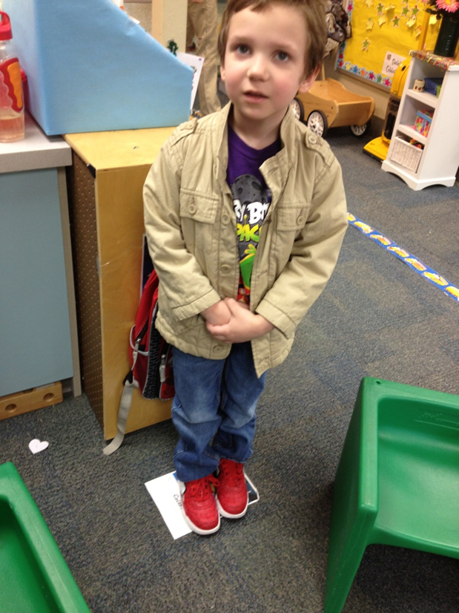
I had a little boy in my classroom who had a really hard time with the transition to leave the classroom.  He was overwhelmed by the number of children at the coat closet and with too many people standing by him in line.  

He LOVED Angry Birds!  So, we used some visuals to help him have a "landing pad" whenever we needed to line up to leave the room.  His space was away from the other children and it helped everyone feel more safe when they were lining up.  As you can see from the smile on his face he felt happy when he could line up successfully!  For him, success looked a little different than it did for the other children.  


Here are a couple of my favorite websites for ideas and printables for various visuals for the classroom or home:


If you've done all this and you still have children that are resistant to transitions then it could be a relationship issue.  That will be our topic for next week!  Stay tuned to learn what to do when you've MAP-ed it out and really reinforced the routines and expectations with lots of practice and visuals, but it's still not working!

Tuesday, January 12, 2016

Brain Smart Transition Tips that Work


Whether you're a teacher or parent you'll agree that your day is full of transitions.  Parents and teachers alike have told me over the years how challenging transitions can be whether in the classroom or home.

This post is the first of a series of posts about strategies you can use regardless of your environment to help you and your children be more successful with transitions.

Did you know that the most difficult transition of the day is the transition from home to work or school?  I would add that an equally challenging transition can be at the end of the day when you return home.

Today, we are going to begin the series by learning a skill called the M.A.P. technique.  If you can add this basic tool from Dr. Becky Bailey's Conscious Discipline to your toolbox you will discover pretty quickly that your transitions are transformed!

The M.A.P. technique is an assertiveness tool that will help you think through the transitions that occur throughout your day.  It will help you develop a road map for SUCCESS!  If you were traveling from Indianapolis to Orlando you would plan out your trip and hopefully look at a map to help you get there successfully.  Of course there are always a few bumps in the road, but the whole trip goes smoother if you plan ahead.  The M.A.P. technique works the same way.  It helps you plan ahead so everyone feels more successful in the end!  :)

The first basic question to ask yourself is, "What do I want this time of day to look like, sound like, feel like?"  The answer to that question will be your "destination".  It will help you and your children figure out where you're going.

If you have older children you could even get them involved in the planning process.  The answer to this basic question will guide you as you M.A.P. out the routine.  This is how you will get to your destination!


What does M.A.P. Stand for?


M=Model your procedures and expectations
A=Add Visuals
P=Practice, practice, practice

I remember when I first began learning about Conscious Discipline and dinnertime  in our home meant CHAOS!  I returned from a Conscious Discipline training inspired to use these strategies to figure out a different way to do dinnertime.

I began by having a conversation with my husband to help us figure out what our "destination" as a family for dinnertime would be.  His dinner experience was very different than mine as a child.  He was an only child and his dad worked at night.  He and his mom would usually eat dinner in front of the TV while watching recorded soaps form the day.

I came from a family of five.  My mom and dad felt that dinnertime at the table together was very important.  We had specific seats to sit in, we said prayer, asked to have the food passed while using good manners, and asked to be excused when we were finished.

As you can see, we came from very different experiences.  Our destinations looked a little different.  This conversation helped us figure out what we wanted the dinnertime experience in our home to look like, feel like, and sound like.  It was so helpful to get on the same page.

Next, I worked with  my children who were about 5 and 7 at the time to make a book about dinner in our home.  First, I talked to them about the routine we would follow at dinner.  I modeled what their dad and I wanted it to look like, feel like, and sound like.  They agreed to be my models while I took pictures of them completing each part of our dinnertime routine.  I turned the pictures into a very simple book that showed step by step what we would do at dinner.  We practiced the routine by reading the book and acting it out.

The book was so helpful at the time.  We used it frequently to help us remember how to make the transition from playtime to dinnertime without yelling and resistance.  It was also helpful to follow-up with encouragement when people did what I wanted them to do.  Learn more about that here .

One of the difficult transitions in my classroom happened after snack time every day.  Meals present a different dilemma because children get done various rates.

We used the M.A.P. technique and came up with a routine to help ease the transition from snack to the next activity.  We called the next activity "Book Buddies".  Here are some of the pictures and steps we used to teach and practice this routine with the children so everyone would be successful!


I hope you find some inspiration here to help you think through your transitions and develop a plan that will help you and your children feel more successful!  In our next post in this series will focus on some visuals you can use to help with transitions.  I will also be sharing some free visuals that you could print out so you'll have a tool to use right away!  Stay tuned!


Wednesday, January 6, 2016

Conscious Discipline Book Study

The truth is when I attended my very first Conscious Discipline workshop I really didn't think I needed it.

After all, I had a whole semester of behavior management in college!

When I was faced with challenging behavior I typically came up with some sort of positive strategy to help gain more of the behavior I was looking for.  In other words, I used rewards such as treasures, stickers, praise, and special privileges.

When all else failed and I didn't know what else to do I turned to punishments.  I used time out and loss of privileges at school and at home with my own children I sometimes even spanked them.

I'll never forget the day I spanked my young son and he looked at me and laughed.  I knew there had to be a better way.  I didn't want to raise my children in a place where violence and loss of love were used to control behavior.

I am forever grateful that my coworker dragged me into that first Conscious Discipline workshop.  Boy were my eyes opened that day!  I really didn't know a whole lot about social-emotional development at the time nor did I know much about the most recent brain research.

As soon as I left that workshop I ran right down stairs to the exhibit hall and purchased the Conscious Discipline book.  I was SOLD!  I wanted to learn everything I could about lovingly guiding my children to live more disciplined lives.  That was in 2007.  My life will be forever changed!

Has this been an easy journey?  NO!

The most difficult part of this journey has been letting go of the past and empowering myself to embrace the power within so I can be these me I can be!  It has been very painful at times, but also filled with JOY!

It's easy to set up a cute little Safe Place, memorize a new I Love You Ritual, or teach a child to use their BIG voice.  The hard part is doing it YOURSELF!

Now that my own children are teenagers and they have lived with Conscious Discipline for the past 9 years of their lives I can really see the results of our commitment to teach rather than punish.  (That's not to say we get it perfectly.  We've made LOTS of oopsies, but we learn from our mistakes and rebuild relationships and try again.)

One skill that I see really growing in my children right now is the skill of Empathy.  I hear them use it with their friends and they even use it with me.  It is so rewarding to hear the words you've tried to model and teach to your children come out of their mouth without any prompting.

Could I do this on my own?  I really don't think so.  It is because Dr. Becky Bailey has given me so many structured tools and loving guidance that I have been able to develop these skills.  It is also because I have not tried to face this journey alone.  I have reached out in faith to my family, friends, my Conscious Discipline Family, and even other professionals to help me develop in my areas of weakness.  I could not do it alone.

That's why I'm writing to you today.

One of the commitments I'm going to make over the course of the next year is to read a chapter a month of the new Conscious Discipline book.  I've read most of it before, but this time I want to slowly go through the chapters, let it marinate and allow time to really implement that concept into my daily life.  I'm going to use the online book study as my guide and I'm going to post about my journey.

I would be thrilled if you would join me on this journey.  Are you looking for a tool to help you transform your relationship with your husband, children, coworkers, or the children in your classroom?  This book will do that for you if you make a commitment to read the chapters, complete the exercises, and take steps to implement what you're learning in your daily life.

I hope you'll join me!

You can get your copy of the Conscious Discipline book by going to the Conscious Discipline website.  There won't be any assignments or certificates, just an opportunity to develop yourself because it's what YOU want to do.  Because you're worth it!  I will blog monthly about my journey and encourage you along the way via social media.  I would love it if you would comment on this blog entry to let me know you're joining me in this journey.  I would also like to connect with you on Instagram, Facebook, and Twitter where you can # your entries about the reading with #cdbookstudy2016.

I will be reading and discussing Chapter one in February.  Join the conversation.

Are you willing?


Sunday, January 3, 2016

When Fear Whispers in Your Ear


Let's face it, teachers love STUFF!

I remember when I was growing up how often my mom and the other teachers I knew collected STUFF!  They saved everything from egg cartons, shoe boxes and toilet paper tubes to pie pans, rubber bands, and Pringles cans!  For heaven's sake don't throw away the Christmas cards!  :)

Over the years I realized the value in salvaging STUFF so it could be used in my classroom.  This ability to see potential in the things others discard was passed down to me by many generations of teachers!  

My husband has a really hard time understanding this.  LOL!  What appears to him as just a regular appliance box, to me is a bear den where my preschoolers can go to be alone or pretend to hibernate like other animals in winter.  When I return from the library book sale with another bag of children's books he sees clutter and I see adventures, literacy, and potential for connecting with a child in a special way that only the really good books can provide.

You should see my garage!  Many years ago a dear friend and mentor taught me how to organize my STUFF into categories and plastic totes.  Through the years the shelves in my garage haven't held the normal tools and yard supplies you would expect.  No, they have been filled instead with the treasures of a preschool classroom.  Every month I would load my car up with box upon box of materials to help me turn my classroom in to a magical learning experience for the children I loved so dearly.  I wanted to do everything I could to give them the best childhood experience possible and I really thought I needed STUFF to do that.

I think its a sign of true love when your husband thinks your visions are nonsense, but he makes room for them in the garage, helps you carry the boxes, and smiles with adoration (or maybe an eye roll) when you return with another bag from the Target Dollar Spot!  

With the emergence of the internet (yes, I began teaching before there was an internet) it seems that the STUFF that teachers seek now are downloadable, printable, laminate-able (is that a word) and often plugged into an outlet!  Now we can share all our wonderful ideas for how to use all this STUFF via the world wide web on sites like Teachers Pay Teachers, Pinterest, and blogs like this!

Three years ago I made the decision to leave the classroom.  It was a really difficult decision to leave the only job I'd known since I graduated from college.  I LOVE teaching!  I especially delight in the early childhood years.  Three-year-olds get excited about toilet paper tubes, marble painting, and appliance boxes too!  They light up the way I do when I discover a wonderful new children's book and have the opportunity to use all my funny voices with the characters!

After 18 years of teaching you can probably imagine how much STUFF I had.  Eighteen years of rummage sales, book fairs, donations, routines, and many many visits to the Dollar Store!

I had a really hard time letting go.

Deep inside of me I still see potential in many of the things I've collected over the years.  It stirs something deep in my soul to anticipate the smiles and bright eyes of children as I share my new discovery with them.  My heart beats faster, my eyes widen, and my face brightens with excitement and as a teacher you get to do it again and again!

Over time I have been able to dig deep and slowly but surely help much of my beloved STUFF find new homes where it will be well loved for years to come.

Now I am down to my very favorites.  These are the ones that I long to use again.  Whether in blog posts or someday in a classroom of my own,  Examples include about 10 years of Mailbox Magazines.  Those little magazines hold treasure between the covers. Teachers from all over the globe have contributed their finest ideas to the pages held within.


How about those teaching units for Clifford, Dr. Seuss, Eric Carle, and Chicka Chicka Boom Boom?  Out of all of my files these are the ones that were my favorites!  Year after year the children and I enjoyed many activities with these favorite children's books.  Letting go of them means letting go of the hope that they will be used again. 


In this journey that I have been on over the past nine years with Conscious Discipline I have learned many things.  Each year I discover new areas of my life where I had no idea I needed to grow.  2016 seems to be the year for growing in truth.  Each year my family and I do the One Word Challenge and my word this year is Truth.

So begins the next chapter in this story.

All of this said, the truth is that I have a hard time letting go of stuff.  In fact, I probably put too much importance on the stuff.


I think there is definately value in having STUFF to use as tools in your classroom to help you bring new and creative lessons to your students.

NOW hear this...

What I have learned and continue to learn is that the magic isn't in the STUFF...the magic is in YOU.  When you rely so heavily on all of the STUFF whether it is an idea book, art materials, appliance boxes, or the latest TPT download you lose touch with what matters most--Your belief in yourself!

I am in the process of organizing and redecorating my office.  I decided that it was time for a real big girl office!  Since these are weak skills for me I hired a professional organizer.  She is also a former preschool teacher so she totally understands my condition.  :)  She gets it.


As we began to work in my office she asked about the Mailbox Magazines and numerous children's books I continue to hold on to.  I explained with tears in my eyes how precious they were to me and why I have such a hard time letting go of them.  They hold so much potential.


The truth is that they also hold guilt.

Guilt about all the blog posts I hoped to write, but never did.  Guilt about the fact that they were collecting dust instead of more memories.  

The truth is they are a distraction.

They take my heart and mind away from where I presently am.  Each time I see them they either take me to the past lamenting what is gone or to the future and how I wish to use them again.

The truth is I don't need them now.

With all this distraction it is keeping me from being my best and giving my best to where I am right now.  My OCD Organizational friend helped me see that I have what I need right now inside me and I need to believe that.  God will supply all I need when the time comes and now I am being called to let go.  Trust that the magic is in me.

It was fear that was holding me back and whispering in my ear...


"You never know."

"You're not really that creative on your own."

"You may need them some day."

"You worked so hard to collect all that stuff.  What if you can't find it again."

"It will make you a better teacher, blogger, trainer, coach, parent if you just hang on to that stuff."


LIES!


The truth is I have all I need and it is well.  Peace and happiness doesn't come from STUFF.  Peace comes from a deep sense of well being knowing you've done your best wherever you are right now.

For me, the truth is I'm not using this STUFF now and haven't used it for the past three years.  It would serve its purpose so much better in the hands of a teacher and young children that will benefit from all these ideas right NOW!  I decided to begin giving some of my treasures to a dear friend who has her very first Head Start classroom.  She is eager to give new life to my old dusty materials and love them well with her bright eyed preschoolers.


Although it was with tears in my eyes that I loaded her car with bags and boxes, I know this is all a part of the circle of life.  She was overjoyed to receive such a gift and it moved her to pay it forward the same day by donating her unneeded van to a family in need.

So what about you?  What are you holding on to that keeps you from being your best self?  You have all the magic you need right inside you and your best lesson plan walks through the door every day.  Don't let all the STUFF distract you so much that you miss what is right in front of you.


Monday, November 30, 2015

Meaningful and Fun Holiday Family Activities

This is one of my favorite pictures of my little girl. 

When she was little her favorite part of the Christmas celebration at our church was seeing baby Jesus. 

Although this photo was taken several years ago, it is still a great reminder of what the season is all about--LOVE!  Taking time to connect and love on the people around you is really the best gift you can give this holiday season!

Sometimes the holiday season gets so busy with parties, shopping, and decorating that we can easily let precious moments with our children slip by. 

I am going to be very intentional about taking time to connect with my family each day this month.  Whether it's a simple butterfly kiss at bedtime or baking cookies for our neighbors what matters is that we slow down and take time to strengthen our connection.  It is also a great opportunity to teach our children to care for others by demonstrating kindness and love.  It doesn't have to take a lot of time, but it can still be meaningful and fun!

If you follow the link below you can print out a free December calendar with over 30 ideas for activities you could use to connect throughout the month.  Work with your child to cut out the ones you like the most and glue them on the dates when you know you will have time to spend on that activity.  When we did it we glued the calendar to a larger piece of construction paper and then decorated the calendar with foam Christmas cutouts.  We then added some ribbon to make a hanger for the calendar so we could hang it up in the kitchen where we were reminded to do our daily activity! 

This would also be a great activity for Sunday School classes, make and take family nights, or "homework" for classroom teachers.

Whatever you do, may you and your family be richly blessed this holiday season in the time you spend together.  I hope your light shines a little brighter as you share your love with those around you!

"Again Jesus spoke to them, saying, “I am the light of the world. Whoever follows me will not walk in darkness, but will have the light of life.” (John 8:12)


https://drive.google.com/file/d/0B2o2onDfM4BxZEJaQzlUUkRnUW8/view?usp=sharing